The Short Version
- What we stripe: new layouts on fresh or freshly sealed pavement, restripes over existing lines, ADA spaces, fire lanes, crosswalks, arrows, stencils and curbs.
- Where: the six North and Central Jersey counties listed in the town list below.
- ADA: a 100-space lot needs 4 accessible spaces, and at least 1 must be a van space. The table below covers every lot size.
- Fire lanes: your local fire official decides where they go and how they are marked. We paint to that decision. How fire lanes work in NJ.
- Weather: striping paint needs at least 50°F in the air and the pavement. Fresh sealer needs at least a day to cure before the lines go down.
- Cost: it depends on linear feet, stencils and whether the lot needs a new layout. Our New Jersey striping cost guide breaks it down.
What We Paint on a Parking Lot
A striping job is more than parking lines. These are the markings North Jersey property owners ask us for most:
- Parking stallsSingle or double lines, straight or angled, sized to your aisles.
- ADA and van accessible spacesThe space, the hatched access aisle and the wheelchair symbol.
- Fire lanesCurb or pavement markings where the fire official requires them.
- CrosswalksBar or ladder crosswalks where people walk across a drive lane.
- Stop bars and wordsSTOP, DO NOT ENTER and similar text at exits and turns.
- Directional arrowsOne-way flow around buildings, drive-thrus and loading areas.
- No-parking hatch zonesStriped islands that keep corners and hydrants clear.
- Drive-thru and loading lanesLane lines and stencils such as DRIVE THRU or LOADING.
- Curb paintingPainted curbs that mark edges and no-parking areas.
- Speed bump markingHigh-visibility stripes on bumps and humps.
Related pages: ADA striping, speed bumps and warehouse and truck court striping.
One Real Layout, Marking by Marking
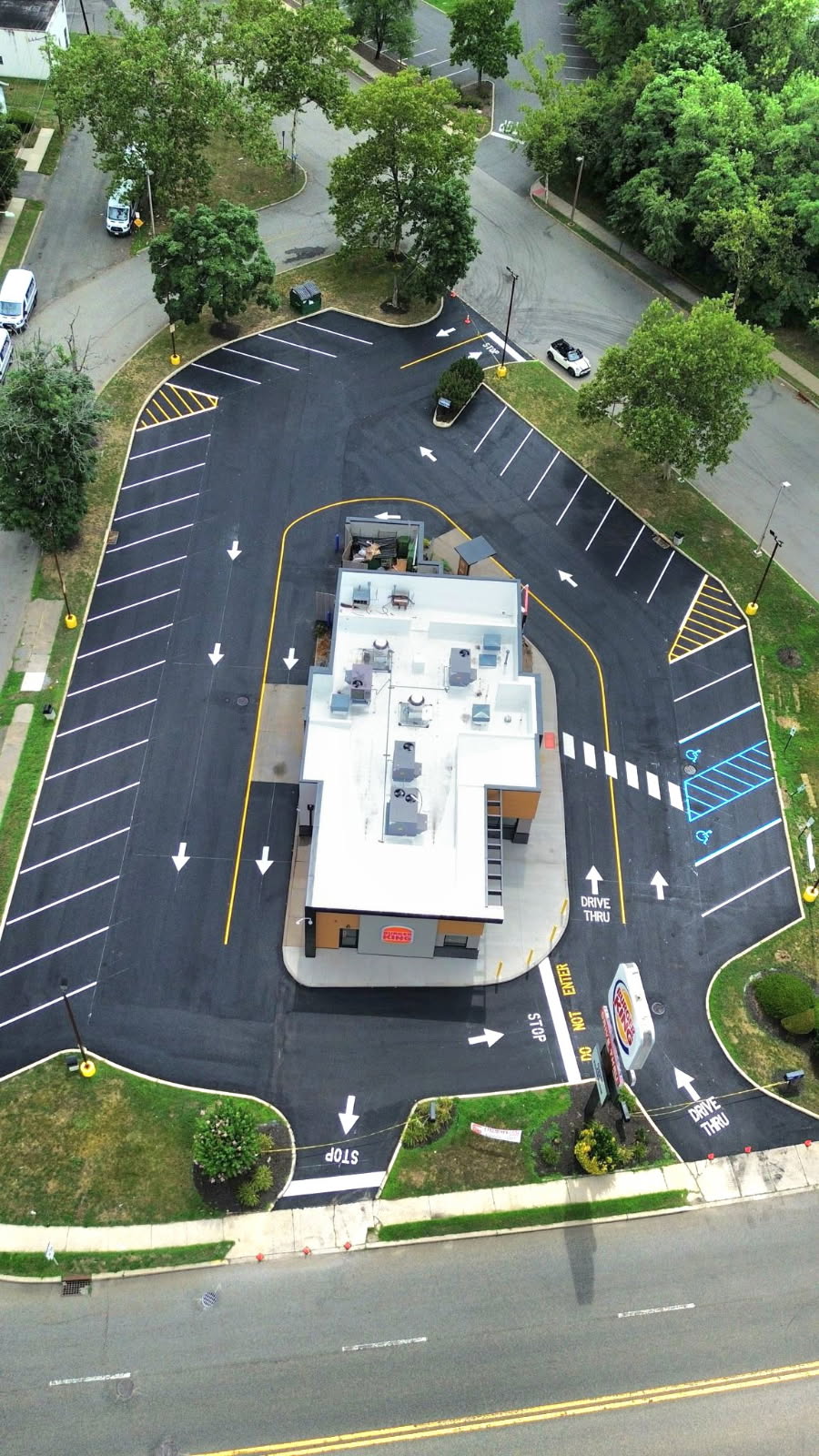
The photo at the top of this page is a drive-thru restaurant lot our crew striped. Every marking in it has a job:
- White stall lines run along the outer edges so cars park facing the landscaping, not the drive lane.
- Two accessible spaces sit near the building and share one blue hatched access aisle, with a wheelchair symbol in each space.
- Yellow hatched zones fill the corners where a parked car would block the turn.
- A yellow lane line wraps the building and keeps the drive-thru queue out of the parking aisle.
- DRIVE THRU text and arrows point drivers into the queue from both entrances.
- Crosswalk bars cross the drive-thru lane where staff and customers walk.
- Stop bars with STOP text sit at the exits, and DO NOT ENTER keeps one of them exit-only.
How Many Accessible Spaces Your Lot Needs
Count every space in the lot, including the accessible ones. Then find that total below. The numbers come from Table 208.2 of the 2010 ADA Standards. New Jersey's building code is the 2024 International Building Code with state changes, and it uses the same table. The state's Barrier Free Subcode points to Chapter 11 of that code for accessibility.
| Total spaces in the lot | Accessible spaces required |
|---|---|
| 1 to 25 | 1 |
| 26 to 50 | 2 |
| 51 to 75 | 3 |
| 76 to 100 | 4 |
| 101 to 150 | 5 |
| 151 to 200 | 6 |
| 201 to 300 | 7 |
| 301 to 400 | 8 |
| 401 to 500 | 9 |
| 501 to 1,000 | 2% of the total |
| 1,001 and over | 20, plus 1 for each 100 (or part of 100) over 1,000 |
Two rules change the count:
- Each lot counts on its own. A site with two lots works out the accessible spaces lot by lot, not from the site total.
- One in six must be van accessible. For every six accessible spaces, or part of six, at least one must be a van space.
Worked examples from the table:
- 20 spaces: 1 accessible space, and it must be a van space.
- 120 spaces: 5 accessible spaces, at least 1 of them van.
- 250 spaces: 7 accessible spaces, at least 2 of them van.
- 600 spaces: 12 accessible spaces (2 percent), at least 2 of them van.
Sizes, Aisles and Location
- Car space: at least 96 inches (8 feet) wide.
- Van space: at least 132 inches (11 feet) wide. It can be 96 inches if its access aisle is also 96 inches wide.
- Access aisle: at least 60 inches (5 feet) wide, running the full length of the space. Two accessible spaces may share one aisle.
- How widths are measured: from the center of one painted line to the center of the next.
- Aisle marking: the aisle must be marked so people do not park in it. The ADA leaves the method and color to state and local rules.
- Level ground: the aisle sits level with the space. Slopes up to 1:48, about 2 percent, are allowed.
- Van height: van spaces, their aisles and the drive route to them need 98 inches of clearance. That matters in garages.
- Location: accessible spaces go on the shortest accessible route to an accessible entrance.
On color, New Jersey's Division of Disability Services guide says accessible spaces and aisles are painted in a contrasting color, most often blue. The guide itself says it is not a substitute for the law.
New Jersey's Sign Rule
New Jersey adds its own sign rule to the building code, as section 1106.10 in N.J.A.C. 5:23-3.14:
- Every accessible space gets an R7-8 sign showing the International Symbol of Accessibility.
- Beneath it goes a penalty sign with this wording:PENALTY $250 FIRST OFFENSE
SUBSEQUENT OFFENSES $250 MINIMUM AND/OR UP TO 90 DAYS COMMUNITY SERVICE
TOW AWAY ZONE - The penalty sign is centered at the head of each space.
- The bottom of the lowest sign sits about 60 inches up. It goes to about 72 inches when the sign is perpendicular to the sidewalk.
- Van spaces also need a "van accessible" designation on the sign, under the ADA.
Signs are posts and panels, not paint. Ask whether a striping quote includes them.
What Happens When Spaces Are Wrong or Blocked
- Drivers: parking in an accessible space without a permit costs $250 for a first offense under N.J.S.A. 39:4-197.
- Private lots are covered: the ban applies to marked accessible spaces on private property too, and police enforce it there (N.J.S.A. 39:4-138).
- Owners: whoever owns or controls a lot open to the public must keep accessible spaces and curb cuts clear. Snow and ice must go within 24 hours after the storm ends. The penalty is $500 to $1,000 per blocked space (N.J.S.A. 39:4-207.9).
- Federal cases: in its own ADA cases against businesses open to the public, the Justice Department can seek up to $118,225 for a first violation. A later violation can bring up to $236,451 (28 CFR 85.5). Those are ceilings, not automatic fines.
Fire Lanes: Who Decides and How They Are Marked
New Jersey's fire code is the 2018 International Fire Code with state changes (N.J.A.C. 5:70-3.1). For a lot owner, it comes down to five points:
- The fire official decides. Your local fire code official may require and designate fire lanes on public or private property (N.J.A.C. 5:70-3.2).
- Site plan approvals still count. A new fire lane cannot conflict with earlier planning or zoning board approvals unless that board approves it in writing.
- The wording is set. Where the fire official requires markings, they include the words NO PARKING—FIRE LANE (2018 IFC section 503.3).
- Faded is not good enough. Fire lane markings must be kept clean and legible. They must be repaired or replaced when they fade.
- No parking in them. Fire apparatus access roads may not be blocked in any way, including by parked cars (section 503.4).
The state code does not set one stripe color, width or sign size for every town. Get the marking detail from your fire official before paint goes down. We paint to that detail. For what nine North Jersey towns require, deadlines after a notice and 2026 costs, see our New Jersey fire lane striping guide.
What the Line Colors Mean
The federal road-marking manual, the MUTCD, allows five marking colors: yellow, white, red, blue and purple. On roads, the main ones mean:
- Yellow lines separate traffic moving in opposite directions.
- White lines separate traffic moving the same way and mark the right-hand edge.
- Blue is added to white on spaces for people with disabilities.
- On-street parking lines are white.
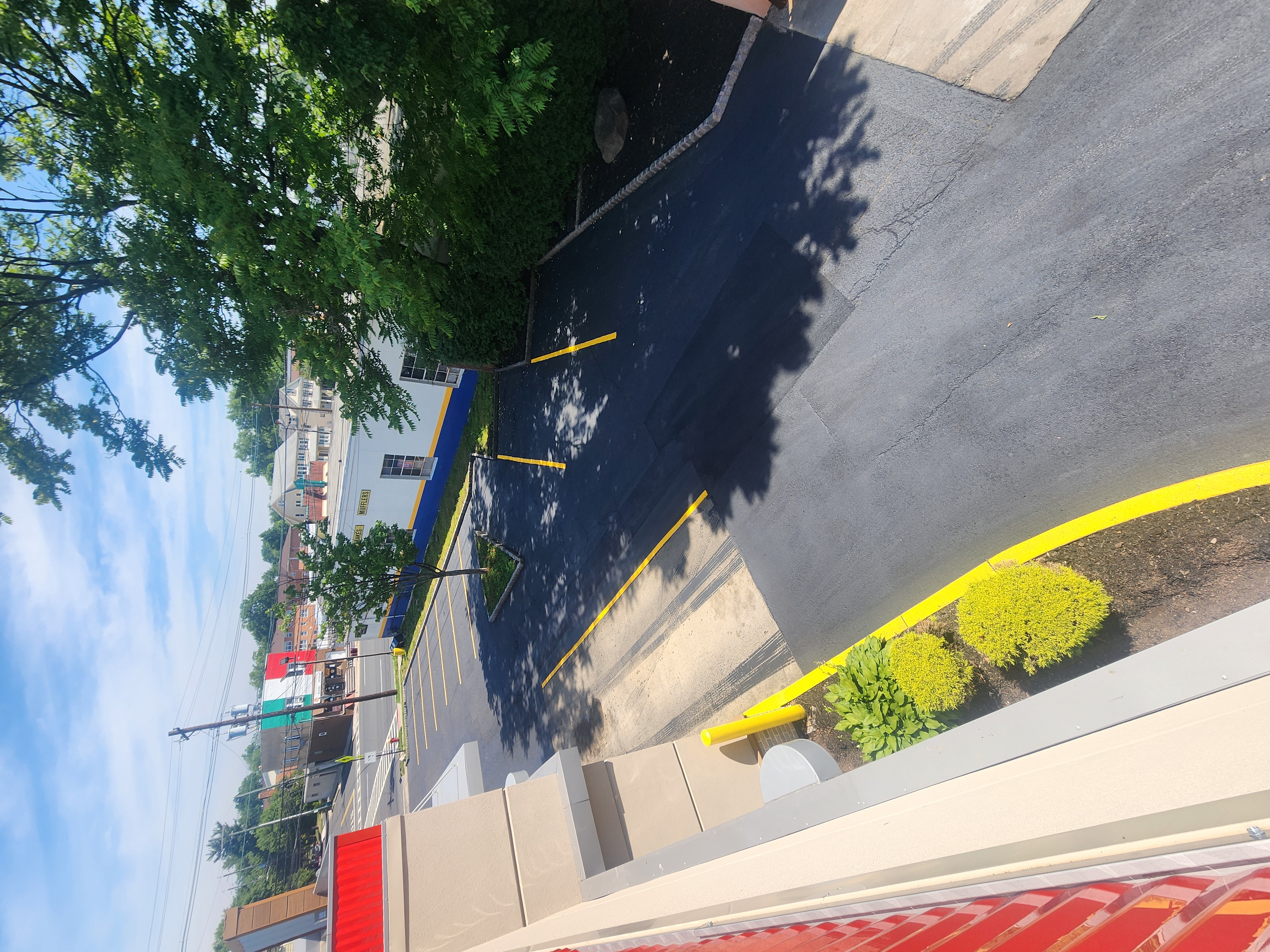
Inside a parking lot, it works differently. The MUTCD says it does not apply to parking areas or their driving aisles, public or private. That is why stall lines are white on one lot and yellow on the next. The two photos on this page show both. For accessible spaces, the ADA and New Jersey's building code set the rules. The building code borrows the MUTCD's R7-8 sign.
Seal First, Then Stripe
Sealcoat covers every line on the lot. Once a lot is sealed, it has to be striped again. That is why sealcoating and striping are usually one job.
The lines wait for the sealer to cure. SealMaster, which makes both pavement sealer and striping paint, says to allow at least 24 hours.
New asphalt needs longer, and paint makers differ:
- SealMaster: about 4 weeks, until the surface is free of light oils.
- Sherwin-Williams: ideally several months. It suggests a test stripe first, and a thin coat if new asphalt must be painted sooner.
When cars can drive on the lot again has its own guides: sealcoat dry time and new asphalt cure time.
When the same company seals and stripes, both jobs go on one schedule. You plan one closure, and nobody waits on a second contractor.
If the lot needs more than a seal, see commercial sealcoating, parking lot repair and parking lot paving.
Paint, Weather and How Long Lines Last
New York State DOT publishes how long each marking material lasts on its roads:
- Waterborne traffic paint: about 12 months, depending on traffic, location and the weather when it went down. NYSDOT repaints its secondary roads every year.
- Epoxy: about 2 years on asphalt and concrete.
- Thermoplastic: about 3 years in ideal conditions. Plows can shorten that, because the material is thicker.
These are road figures. A lot's own traffic, plowing and salt decide how long its lines last.
The 50-Degree Rule
- NYSDOT puts traffic paint down only when the air and pavement are 50°F and rising, and not damp.
- Sherwin-Williams says not to apply its waterborne striping paint below 50°F, above 85 percent humidity, or below the dew point.
- SealMaster says the temperature must not drop below 50°F for 24 hours after painting.
- NYSDOT warns that colder air or pavement reduces how well markings perform and how long they last.
So a late-season job needs a warm day and a warm night after it. Whoever you hire, ask which material the quote uses, and get it in writing.
Restripe or New Layout?
Restripe
New paint over lines you can still see, in the same places. Right when:
- the layout still works for your traffic
- the space count and ADA spaces are still right
- the old lines are faded but visible
New layout
The lot is measured and laid out again. Right when:
- the lot was just paved or sealed and the lines are gone
- you are adding or moving accessible spaces
- traffic flow, stall size or aisle width is changing
A third case catches owners out: changing the layout on a lot that still shows its old lines. Paint the new lines over the old ones and drivers see both. The old lines have to disappear first, and sealcoat is the usual way to cover them. That is one more reason a re-layout often starts with a seal.
Signs a lot is due: lines you cannot read at night or in rain, worn wheelchair symbols, fire lane text you cannot make out, and lines lost under patches or crack repair.
How a Striping Job Runs
- Walk and measure. We count the spaces and check the ADA count against the table on this page.
- Written estimate. It lists the lines, stencils and any ADA or fire lane work.
- Layout. On a blank lot, the layout is marked before any paint goes down.
- Clean the lines. Dirt and loose material come off so the paint bonds to the pavement.
- Paint and stencil. Lines first, then symbols, arrows and words.
- Keep traffic off. Cones stay up until the paint is dry, then the lot reopens.
Common Striping Mistakes to Avoid
- Painting on damp, dirty or cold pavement. Paint on a dusty surface bonds to the dust, not the asphalt, and peels early. Below 50°F it wears out sooner.
- Striping too soon after sealing or paving. Fresh sealer needs at least a day to cure. New asphalt needs weeks or more.
- Counting ADA spaces from the wrong total. The count comes from all the spaces in the lot, not one row. Each lot on a site counts on its own.
- Leaving the access aisle blank. The aisle next to an accessible space has to be marked so nobody parks in it.
- Painting a new layout over old lines. Drivers see both sets and park wherever they like.
- Guessing at fire lanes. The fire official decides them. Painting your own version can mean doing it twice.
- Striping a lot that needs a seal first. Fresh lines on faded, cracked pavement look worse, not better, and get covered the next time the lot is sealed.
What Different Lots Need
- Restaurants and drive-thrus: lane lines, queue stencils, stop bars and one-way arrows.
- Retail and strip centers: stall counts that match the ADA table, crosswalks to the storefronts and fire lanes along the building.
- Warehouses and truck courts: trailer stalls, dock approach lines and hatched no-park zones. See warehouse striping in NJ.
- Offices and medical buildings: accessible spaces on the shortest route to the entrance and reserved stall stencils.
- Churches, schools and HOAs: crosswalks, fire lanes and clear drop-off lanes.
- Lots with EV chargers: New Jersey fines a car that is not charging in an EV space $55, then $100, then $200. That rule applies where the space has signs and pavement markings visible day and night (N.J.S.A. 39:4-138).
Parking Lot Striping Questions
How many accessible parking spaces does my lot need?
Count every space in the lot, then use Table 208.2 of the 2010 ADA Standards. It starts at 1 accessible space for 1 to 25 spaces, 2 for 26 to 50, 3 for 51 to 75 and 4 for 76 to 100. At least 1 in every 6 accessible spaces must be van accessible. So a lot with one accessible space needs it to be a van space. Each lot on a site is counted on its own.
How wide are ADA parking spaces and access aisles?
Under the 2010 ADA Standards, a car space is at least 96 inches (8 feet) wide. A van space is at least 132 inches (11 feet) wide, or 96 inches if its aisle is also 96 inches wide. Access aisles are at least 60 inches (5 feet) wide and run the full length of the space. Widths are measured from the center of the painted lines.
Who decides where fire lanes go in New Jersey?
Your local fire code official. Under New Jersey's fire code changes in N.J.A.C. 5:70-3.2, the fire official may require and designate fire lanes on public or private property. Where markings are required, section 503.3 of the 2018 International Fire Code, which New Jersey adopts, says they include the words NO PARKING—FIRE LANE. They must be kept clean and legible.
How often should a parking lot be restriped?
Lines are due when you cannot read them at night or in rain, and after every sealcoat. As a guide, New York State DOT rates waterborne traffic paint at about 12 months on its roads. It repaints its secondary roads every year. Fire lanes are stricter, because the fire code requires their markings to stay legible.
What temperature do you need to stripe a parking lot?
At least 50°F, in both the air and the pavement, for waterborne striping paint. Sherwin-Williams also rules out humidity above 85 percent and temperatures below the dew point. SealMaster says the temperature should not drop below 50°F for 24 hours after painting.
How long does parking lot striping paint take to dry?
Fast-dry waterborne paint can be quick. Sherwin-Williams rates its fast-dry striping paint at no pickup in under ten minutes when properly applied. Traffic stays off until the lines are dry, then the lot reopens.
How long after sealcoating can a parking lot be striped?
SealMaster says to let fresh sealer cure for at least 24 hours before painting lines. New asphalt needs longer. SealMaster says about 4 weeks. Sherwin-Williams says ideally several months, with a test stripe first.
Can I stripe my own parking lot?
Touching up a few faded lines is simple work. A full layout is harder because of the rules. You need the right accessible space count, the space and aisle widths, New Jersey's sign rule and your fire official's fire lane detail. Getting those wrong can mean doing the job twice.
Who has to clear snow from accessible parking spaces in NJ?
The person who owns or controls a lot open to the public. Under N.J.S.A. 39:4-207.9, snow or ice blocking accessible spaces or curb cuts must be removed within 24 hours after the storm ends. The penalty is $500 to $1,000 for each blocked space.
Parking Lot Striping by Town
Each town page covers the local side of the job. Pick your county, then your town.
Union County
Essex County
Passaic County
Middlesex County
Bergen County
Sources
The rules and numbers on this page come from these documents, checked in September 2026.
- U.S. Department of Justice, 2010 ADA Standards for Accessible Design, sections 208, 216 and 502
- International Code Council, 2024 International Building Code, Chapter 11 (Table 1106.2 and section 1106.6)
- N.J.A.C. 5:23-3.14, New Jersey building subcode, including the state's section 1106.10 on accessible parking signs
- N.J.A.C. 5:23-7, New Jersey Barrier Free Subcode (points to Chapter 11 of the building subcode)
- New Jersey Division of Disability Services, Guide to Accessible Parking (2026)
- N.J.S.A. 39:4-197, fines for parking in an accessible space
- N.J.S.A. 39:4-138, accessible and EV charging spaces on public and private property
- N.J.S.A. 39:4-207.9, owner duty to keep accessible spaces and curb cuts clear
- 28 CFR 85.5, Justice Department civil penalty adjustments (current eCFR)
- N.J.A.C. 5:70-3.1, New Jersey Uniform Fire Code adoption of the 2018 International Fire Code
- N.J.A.C. 5:70-3.2, New Jersey changes to the fire code, including fire lane sections 503.1.1 and 503.1.1.1
- International Code Council, 2018 International Fire Code, Chapter 5 (sections 503.3 and 503.4)
- Federal Highway Administration, Manual on Uniform Traffic Control Devices, 11th Edition with Revision 1 (December 2025)
- New York State DOT, Comprehensive Pavement Design Manual, Chapter 11: Pavement Markings (April 2024)
- Sherwin-Williams, Hotline Fast Dry Latex Waterborne Traffic Marking Paint, Product Data Sheet 123.04
- SealMaster, SMT-240 Acrylic Traffic Paint specification