Commercial Sealcoating vs Paving in Elizabeth NJ: Decision Framework for Property Managers
Every commercial property manager in Elizabeth New Jersey faces the same question on a five to ten year cycle: do we sealcoat this lot, overlay it, or tear it out and start over? The answer is not a matter of opinion and it is not what the cheapest contractor tells you. It is an observable function of pavement condition, age, traffic load, climate exposure, and dollar math over a 20-year planning horizon. Property managers who get this decision right save tens of thousands of dollars per lot over each cycle. Property managers who get it wrong either sealcoat failing pavement that needs replacement — wasting the sealcoat — or prematurely repave pavement that had five good years left in it.
This guide is the commercial asphalt decision framework for Elizabeth commercial property. It covers the three observable states of commercial asphalt, the crack patterns that tell you what is actually failing structurally versus superficially, age-based decision rules, the specific Elizabeth climate and Port Elizabeth loading conditions that shift the answer, and the 20-year ROI math that puts real numbers on each option. By the end, you will have a defensible framework for your next pavement capital decision, independent of whichever contractor is quoting you.
The Three States of Commercial Asphalt
Every commercial asphalt surface sits in one of three observable states at any given point in its life. Identifying which state your lot is in determines which treatment is appropriate. Treating a "good" lot like a "degraded" one wastes money. Treating a "failed" lot like a "degraded" one throws sealcoat onto pavement that is structurally unfixable and the money is gone.
State 1: Good. The pavement is structurally intact. The surface shows oxidation — color has drifted from rich black to grey-black to grey — but there are no cracks, or there are only fine hairline cracks of less than one-eighth inch width. The surface is smooth; no raveling, no potholes, no settlements. The aggregate is locked in the matrix; you cannot pick stones off the surface with your fingernail. The base and subbase underneath are confirmed stable; no soft spots when you walk it, no birdbaths holding water after rain.
A lot in State 1 needs sealcoating on a cycle of 24 to 36 months. That is the entire capital program. Do that for two or three decades and the pavement will last two to three decades. Oxidation is the only enemy, and sealcoat neutralizes it.
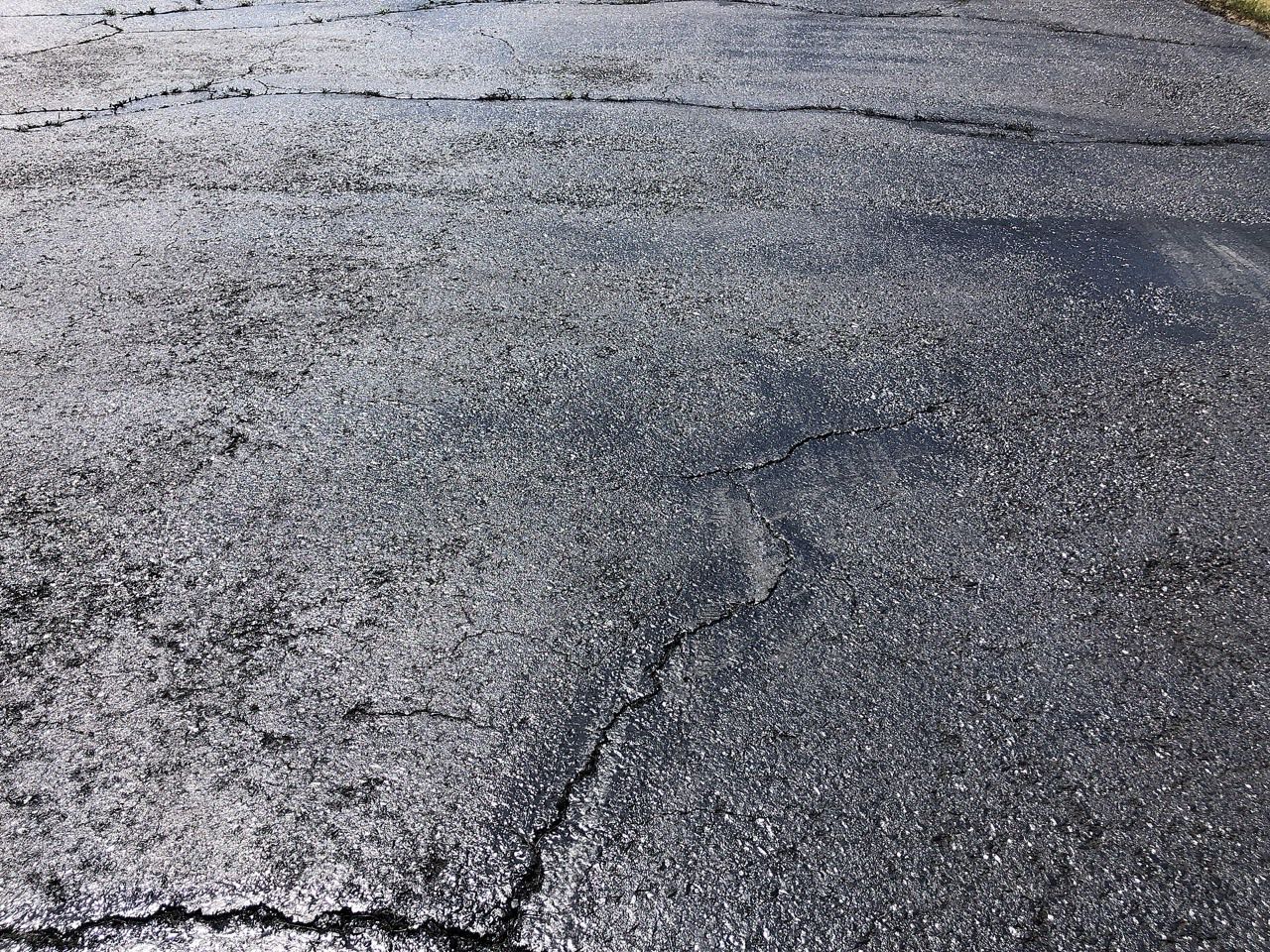
State 2: Degraded. The pavement has observable surface cracking — transverse cracks across the drive lanes, longitudinal cracks along the centerlines, some crack widths up to half an inch, maybe some shallow crack patterns forming in high-traffic zones. There may be spot potholes and a few localized depressions. Raveling — where aggregate is coming loose from the matrix on the surface — is visible in 5 to 20 percent of the area. The surface is grey, oxidized, no black left. But when you walk the lot, the subbase feels stable. There are no major settlements, no alligator cracking beyond isolated patches, and the structure has not failed.
A lot in State 2 needs crack sealing plus an asphalt overlay (usually 1.5 to 2 inches of fresh mat over the milled or cleaned existing surface), OR it needs immediate and aggressive crack repair plus sealcoating on a shortened 18 to 24 month cycle. The overlay buys 8 to 12 more years of life. The aggressive maintenance approach buys 2 to 5 more years before mill-and-pave becomes unavoidable. The right choice depends on age, budget, and whether the underlying structure is sound.
State 3: Failed. The pavement has lost structural integrity. Alligator cracking (interconnected cracks resembling scales) is widespread, not just isolated. Depressions and settlements are common. Potholes reform faster than they can be filled. Raveling affects more than 20 percent of the surface. The subbase may be failing underneath — you can feel springiness, birdbaths hold water, and patches keep popping loose. Water is getting into the base and freeze-thaw has accelerated the degradation.
A lot in State 3 needs full mill-and-pave, or full removal and replacement including subbase work. No sealcoat will save it. No overlay will hold unless the structural failures are dug out and replaced first. Property managers who try to patch-and-seal a State 3 lot spend money that does not last and end up repaving anyway — just two or three years later, after burning capital on failed patches.
Visual Inspection: The 30-Minute Walk-Through
You can classify any Elizabeth commercial lot in under 30 minutes if you know what to look for. Take the walk with a notepad and a digital camera. Document by zone — front of building, middle of lot, back of lot, drive aisles, loading area — because conditions frequently vary across a single lot.
Color. Black or dark grey = well-sealed and probably State 1. Medium grey = oxidized, likely needs sealcoat soon. Light grey or visibly bleached = heavily oxidized, probably State 2 or later.
Cracks. Hairline (less than 1/8 inch) = State 1 acceptable. Open cracks 1/8 to 1/2 inch = State 2 markers, sealable. Cracks over 1/2 inch = significant, may not be sealable, approaching State 3. Alligator patterns = State 3 indicator.
Texture. Tight surface with aggregate locked in matrix = structurally sound. Loose stones pickable with fingernail or scuffing under shoe = raveling, degraded. Surface tearing or rutting = heavy degradation.
Potholes. None or isolated (less than 1 percent of area) = State 1 to early State 2. Repeat potholes in same zones = subbase failure = State 3.
Settlements and depressions. Smooth surface = fine. Isolated birdbaths holding water = early warning. Large depressions over drainage lines or connecting to alligator areas = structural failure.
Edges. Edges cracked, crumbled, or sinking away from curbs = water intrusion into the base. Chronic water intrusion accelerates failure regardless of surface condition.
Drainage. Water should flow off the lot during rain. Standing water 24 hours after rain = drainage problem. Water penetrating into cracks and freezing = the single biggest killer of Elizabeth commercial asphalt.
After the walk-through, you should be able to estimate what percentage of the lot is in each state. A lot that is 80% State 1, 15% State 2, and 5% State 3 is a sealcoat lot with targeted crack and pothole repair. A lot that is 40% State 2 and 30% State 3 is an overlay candidate at best and a mill-and-pave candidate more likely. A lot that is 60% State 3 is a full replacement.
Age-Based Decision Rules
Age is not a perfect predictor, but it sets expectations. Commercial asphalt in New Jersey climate typically follows this trajectory:
| Pavement age | Expected state | Default treatment |
|---|---|---|
| 0 to 2 years | State 1 (may skip first sealcoat) | First sealcoat at 12 to 24 months |
| 2 to 5 years | State 1 with ongoing sealcoat cycle | Sealcoat every 24 to 36 months |
| 5 to 10 years | Transition zone — State 1 to State 2 | Sealcoat + crack repair; inspect annually |
| 10 to 15 years | State 2 territory | Overlay candidate OR aggressive maintenance |
| 15 to 20 years | State 2 to State 3 | Overlay unless structural fail = repave |
| 20+ years | State 3 or close | Mill-and-pave or full replacement |
These ranges assume typical Elizabeth commercial traffic. Heavy truck traffic (Port Elizabeth, distribution, industrial) compresses the timeline by 30 to 50 percent. Low traffic (small office, medical, apartment visitor) extends it by 20 to 40 percent. Neglect of sealcoat cycle compresses it dramatically — an unsealed lot ages twice as fast as a sealed lot once oxidation gets past the surface.
The most common error is assuming age alone dictates treatment. A 12-year-old lot that has been faithfully sealcoated every 30 months may still be in State 1. A 5-year-old lot that was never sealcoated and takes Port Elizabeth truck traffic may already be in State 3. Condition trumps age.
Crack Pattern Interpretation
Cracks tell you what is failing. Reading them right is the single most actionable inspection skill.
Hairline cracks (less than 1/8 inch). Surface-level oxidation cracks. Not structurally significant on their own. Seal them with the next sealcoat cycle; no standalone repair needed.
Transverse cracks. Cracks running across the drive lanes, typically perpendicular to traffic direction. These are thermal cracks — asphalt contracting in cold weather and expanding in warm. Elizabeth's freeze-thaw cycle produces transverse cracks on every pavement over 5 years old. They are routine and sealable up to about 1/2 inch width. Crack sealing with hot-applied rubberized sealant + sealcoat overlay is the standard treatment.
Longitudinal cracks. Cracks running parallel to traffic, usually along centerlines or wheel paths. These are joint cracks (at paver-pass seams) or fatigue cracks (from repeated loading). Longitudinal cracks on paver seams are routine; sealable like transverse cracks. Longitudinal cracks in wheel paths that are deepening and widening may indicate structural fatigue in the base and are a State 2 warning.
Block cracking. Rectangular patterns breaking the surface into distinct blocks, typically 1 to 10 square feet per block. This is the pavement's response to binder oxidation — the asphalt has lost its flexibility and is cracking along stress lines. Seal and overlay buys time. The underlying issue is that the pavement is aging out.
Alligator cracking. Interconnected web of cracks resembling scales or alligator skin. This is the critical one. Alligator cracking indicates base failure — water has gotten in, the subbase is moving, and the asphalt layer is flexing and cracking in response. Alligator cracking cannot be sealed away. It can only be dug out, the subbase repaired, and the section repaved. Isolated alligator patches (less than 10% of lot) = repair patches and overlay. Widespread alligator (more than 25% of lot) = full replacement.
Edge cracking. Cracks at the pavement edge, often accompanied by crumbling. Water is undermining the edge. Edge cracking expands inward if left alone. Curb, drainage, and edge repair are the fix.
Slippage cracks. Crescent-shaped cracks in high-shear zones (turnarounds, stop approaches). The surface layer is shearing against the base. Localized mill-and-pave patches are the fix; sealcoating over slippage is cosmetic only.
Reflective cracking. Cracks in a new overlay that trace underneath cracks in the old pavement. Indicates that the overlay was placed without properly addressing the underlying cracks. Preventable with proper prep on the overlay; if already present, control with crack sealing.
The 20-Year ROI Math
For a typical 30,000 square foot Elizabeth commercial lot (roughly 100 parking spaces), the 20-year cost curves for three different strategies look approximately like this in 2026 dollars.
Strategy A: Proactive sealcoat cycle (best case).
| Year | Action | Cost |
|---|---|---|
| 0 | Inherit State 1 lot | $0 |
| 2 | Sealcoat + stripe | $6,500 |
| 5 | Sealcoat + stripe + crack seal | $8,500 |
| 8 | Sealcoat + stripe + crack seal | $9,000 |
| 11 | Sealcoat + stripe + crack seal + targeted pothole repair | $11,000 |
| 14 | Overlay (1.5 inch) + restripe | $45,000 |
| 17 | Sealcoat + stripe | $7,500 |
| 20 | Sealcoat + stripe | $8,000 |
| 20-year total | $95,500 |
Strategy B: Deferred maintenance (typical case).
| Year | Action | Cost |
|---|---|---|
| 0 | Inherit State 1 lot, skip sealcoat | $0 |
| 5 | First sealcoat, lot now State 2 | $7,500 |
| 8 | Crack repair + overlay deferred | $5,000 |
| 10 | Overlay (2 inch) — lot has moved toward State 3 | $55,000 |
| 13 | Sealcoat + stripe | $8,000 |
| 16 | Sealcoat + stripe + crack seal | $10,000 |
| 19 | Mill-and-pave — structural failure | $120,000 |
| 20-year total | $205,500 |
Strategy C: Neglect to failure.
| Year | Action | Cost |
|---|---|---|
| 0 | Inherit State 1 lot | $0 |
| 5 | Nothing | $0 |
| 10 | Nothing; lot now State 3 | $0 |
| 12 | Pothole repair crisis mode | $8,000 |
| 14 | More patching | $6,000 |
| 16 | Full mill-and-pave | $130,000 |
| 18 | First sealcoat on new lot | $7,000 |
| 20 | Sealcoat | $7,500 |
| 20-year total | $158,500 |
Strategy A — proactive sealcoat cycle — costs 46% of what Strategy B costs and 60% of what Strategy C costs over 20 years. Strategy C also requires the property owner to absorb two to four years of degraded appearance, liability exposure from pothole injury claims, and tenant complaints. The math is unambiguous: proactive sealcoat is the cheapest, longest-lasting, lowest-liability approach.
The caveat: Strategy A only works if the lot enters the cycle at State 1. A lot already in State 2 or State 3 cannot be sealcoated back to health. For those lots, the decision is overlay vs mill-and-pave, and the cost math changes accordingly.
For a broader look at paving cost ranges, see our asphalt paving cost guide. For the recurring-cycle sealcoat scope specifically, see our sealcoating services overview.
Elizabeth-Specific Climate and Load Considerations
Elizabeth commercial asphalt lives in a harsher environment than the New Jersey average, and the framework above gets adjusted accordingly.
Freeze-thaw severity. Elizabeth sees roughly 60 to 80 freeze-thaw cycles per typical winter (days when air temperature crosses 32°F). Water infiltrating pavement cracks freezes, expands, and widens the cracks further with every cycle. This is the single biggest driver of premature commercial pavement failure in the region. Sealcoating — by keeping water out of the surface — is the most cost-effective defense against freeze-thaw damage available. Skipping sealcoat cycles in Elizabeth is effectively accelerating freeze-thaw damage.
Port Elizabeth truck load. The 6th Ward industrial zone and Port Elizabeth truck yards carry tractor-trailer, container-chassis, and cargo-handling traffic. A single fully loaded 80,000-pound tractor-trailer does the equivalent damage of approximately 9,000 passenger cars in one pass. Lots taking this traffic age 30 to 50 percent faster than lots taking only passenger and light-commercial traffic. Overlay thicknesses need to be spec'd accordingly — 2 to 3 inches rather than 1.5 — and sealcoat cycles shortened to 18 to 24 months rather than 30 to 36.
Salt exposure. Winter road salt migrates from city streets into commercial lots via tires and plows. Salt does not directly damage asphalt (unlike concrete), but salty meltwater penetrates surface cracks more aggressively than clean water, accelerating freeze-thaw damage. Commercial lots near heavily salted city streets (Route 1-9, Route 27, North Avenue, Elizabeth Avenue) show faster degradation.
Airport and port fuel exposure. Newark Airport-adjacent logistics lots and Port Elizabeth fuel-handling facilities see jet fuel, diesel, and hydraulic fluid spills that chemically attack asphalt binder. Spills that are not cleaned immediately cause localized surface softening and eventually structural failure. Commercial lots in these zones need more frequent inspection and faster response to spills.
UV exposure. Elizabeth latitude and typical cloud cover produce high annual UV dose on pavement surface. UV oxidizes asphalt binder, making it brittle. Without sealcoat protection, UV oxidation is the slow-burn killer even in the absence of freeze-thaw or loading. This is why 30 to 36 month sealcoat cycles are the portfolio standard.
Combined effect. A Port Elizabeth warehouse lot experiencing heavy truck traffic, freeze-thaw cycling, salt exposure, and fuel spills has a realistic 8 to 12 year structural life before mill-and-pave is required, even with perfect maintenance. A residential-adjacent retail lot in the 3rd Ward with light traffic and no chemical exposure can reach 20 to 25 years on the same maintenance cycle. Climate and load are not marginal factors — they shift the framework significantly.
When Sealcoat Is Wrong
There are specific conditions under which sealcoating is the wrong answer. A property manager should push back on any contractor quote that proposes sealcoating a lot exhibiting these indicators.
Widespread alligator cracking. Sealcoat does not repair base failure. Alligator cracking requires patch-and-pave on the affected zones first.
Active potholes reforming after repair. Subbase failure. Structural repair required before any surface treatment.
Raveling over more than 20 percent of the lot. The surface is disintegrating. Overlay is needed; sealcoat bonds to intact aggregate matrix.
Standing water 24 hours after rain. Drainage problem. Grading and possibly subsurface drainage need correction before any surface treatment is worthwhile.
New pavement under 12 months old. Fresh asphalt needs to cure before sealcoating. Sealing too early traps volatiles in the binder. The standard window is 12 to 24 months for first sealcoat.
Temperature below 50°F surface or air. Sealcoat needs warm weather to cure properly. Cold-weather sealcoat is a common source of premature failure.
When Full Repave Is the Answer
There are also specific conditions under which full mill-and-pave or tear-out-and-replace is the right answer, even though it is the most expensive.
More than 25% of the lot showing alligator cracking. Structural failure is portfolio-wide, not localized.
Subbase failure documented by core samples or ground-penetrating radar. Pavement engineers have confirmed the problem is below the surface layer.
Age over 25 years with full maintenance history. Even well-maintained pavement aches out eventually. The binder has lost flexibility and cracks are reforming.
Elevation issues requiring drainage rework. If the lot needs regrading for drainage, it is likely going to be replaced anyway as part of the grading work.
Change-of-use adding traffic class. Converting a retail lot to a warehouse lot, or light-commercial to heavy-commercial, may require structural upgrade that is cheapest to do at full rebuild.
Frequently Asked Questions
How do I know whether to sealcoat or repave my Elizabeth commercial lot?
Walk the lot and classify it against the three states above. State 1 (intact surface, no significant cracks, no alligator patterns, stable subbase) = sealcoat. State 2 (transverse and longitudinal cracks, some raveling, isolated potholes, stable subbase) = overlay or aggressive maintenance. State 3 (widespread alligator cracking, recurring potholes, subbase failure) = mill-and-pave. When in doubt, get two independent bids from separately-owned paving contractors — if both come back with the same treatment recommendation, trust the consensus.
What is the difference between overlay and mill-and-pave?
Overlay places fresh asphalt (typically 1.5 to 2 inches) on top of the existing pavement after cleaning and crack sealing. It is cheaper and faster but does not address underlying structural issues. Mill-and-pave grinds off the existing surface layer (typically 2 to 4 inches) and replaces it with new asphalt, sometimes with subbase remediation in failed sections. It is more expensive and disruptive but addresses structural failures. Overlay works on State 2; mill-and-pave is required for State 3 that is not quite full replacement.
How often should I sealcoat an Elizabeth commercial parking lot?
Typical cycle is 24 to 36 months. Heavy Port Elizabeth or industrial traffic = 18 to 24 months. Low-traffic office or medical = 36 months is often fine. Cycle can be stretched in stable-surface conditions but shortens dramatically once oxidation gets visible.
What happens if I sealcoat a lot that should have been repaved?
The sealcoat money is largely wasted. Sealcoat does not repair cracks larger than about 1/2 inch, does not repair alligator cracking, and does not stabilize a failed subbase. Within 12 to 24 months the underlying failures will reappear through the sealcoat and the lot will still need repaving. This is the single most common expensive mistake in commercial pavement management.
Is it worth sealcoating a lot that is going to be repaved in 2 to 3 years?
Usually no, unless there are specific appearance or liability reasons to do it. The sealcoat will not meaningfully extend the life of a lot headed for repave and the money goes into the repaved surface. Exceptions: if the lot has tenant lease obligations requiring a certain appearance, or if accident liability from faded pavement markings is a concrete risk.
Does Elizabeth's port-adjacent truck traffic really change the decision framework?
Yes, materially. Port Elizabeth truck traffic carries 40 to 80 times the axle load of passenger traffic. A lot taking heavy truck traffic ages 30 to 50 percent faster structurally. Overlay thicknesses need to be increased (2 to 3 inches rather than 1.5), sealcoat cycles shortened, and the timing for mill-and-pave moves up by 30 to 50 percent versus a light-commercial lot.
How much does a full mill-and-pave cost for a typical Elizabeth commercial lot?
For a 30,000 square foot lot, typical mill-and-pave runs $90,000 to $160,000 depending on thickness, subbase remediation scope, and access. Larger lots scale roughly proportionally with some economy of scale. For industrial lots with deeper base requirements, costs run higher. Always get written scope detail — "mill-and-pave" without specifying thickness, subbase work, and ADA restripe is not a scope, it is a hope.
Can I combine sealcoating and striping in one mobilization?
Yes, and you should. Mobilization cost — crew, equipment, setup — runs 20 to 30 percent of a project. Combining sealcoat + restripe in one mobilization typically saves 15 to 25 percent versus doing them as separate jobs. Most Elizabeth property managers on a 30-month sealcoat cycle schedule restripe at the same visit.
Getting Started
If you manage commercial property in Elizabeth New Jersey and you are trying to decide between sealcoating, overlay, and full repave, the right next step is a free condition assessment. We will walk your lot, classify it against the three-state framework, document conditions by zone with photos, and give you a written recommendation with multiple scope options priced individually.
Call Randy directly at Call Randy or submit a quote request online. For Elizabeth-specific paving projects and commercial work in the Port Elizabeth industrial zone, downtown commercial corridor, or residential-adjacent retail, see our Elizabeth NJ service area page. For broader commercial paving context, see our commercial asphalt paving overview, our asphalt paving cost guide, and our sealcoating services page.
The right commercial pavement decision is not the cheapest quote. It is the strategy that minimizes total cost of ownership over 20 years while keeping the lot safe, compliant, and presentable. Proactive sealcoating on intact pavement is the single best investment a property owner can make. Overlay buys time when the surface has degraded but the base is sound. Mill-and-pave is the reset when structural failure has set in. Which one applies to your lot is a matter of what you see when you walk it, not what a contractor tells you. Walk first, decide second, hire third.
Ready to Protect Your Asphalt?
Get a free quote for professional asphalt maintenance and protection services. Our team is ready to help extend the life of your driveway or parking lot.