How Long Does an Asphalt Driveway Last in New Jersey?
Up to 20 years for a well-designed driveway, according to two asphalt industry driveway briefs; the 2020 brief says this of a driveway that is well designed, constructed and maintained. InterNACHI's home life expectancy chart lists 15 to 20 years. None of the three gives a separate number for New Jersey. What New Jersey adds is freezing weather. NOAA's 1991 to 2020 normals count an average of 108.2 days a year with a low at or below 32°F at the Essex County Airport in Caldwell, and on about 88 of them the high rises above freezing. Road agencies describe water that gets under the pavement, freezes and thaws as how potholes form.
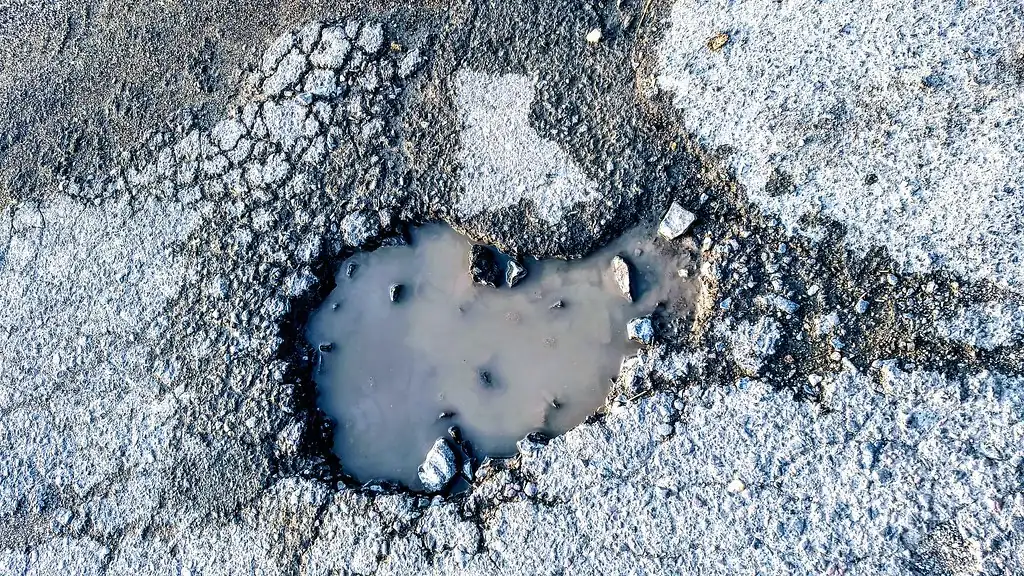
What the two briefs tie a long life to
- A well-designed driveway, built well in the first place.
- Drainage, so water does not pond on the surface.
- Sealer every two to five years, and small cracks filled.
The sections below quote each brief where it says so.
What the Published Guides Say
Each of these three published sources gives a number for a home asphalt driveway, with words that qualify it.
On a phone, swipe the table sideways to see every column.
| Source | Life | What it says with the figure |
|---|---|---|
| Driveway brief hosted by the Asphalt Institute (Colorado association, 2005) | Up to 20 years | “A well-designed driveway” |
| Colorado Asphalt Pavement Association driveway brief, 2020 | Up to 20 years | “A well-designed, constructed and maintained driveway” |
| InterNACHI life expectancy chart for homes | 15 to 20 years | Listed under site and landscaping, elements whose life expectancies the chart says “vary dramatically” |
Both briefs use the same words: trouble-free service for up to 20 years. That is an upper figure for a well-designed driveway, not a promise for every driveway. Our guide to how thick an asphalt driveway should be in New Jersey sets out the layer depths the New Jersey Asphalt Pavement Association lists, and how to check them on a quote.
Why New Jersey Weather Matters
NOAA publishes 30-year climate normals for weather stations. Two of those stations sit in counties we serve: the Essex County Airport (NOAA lists it as Caldwell) and Newark Liberty International Airport. The table counts the average days a year when the low, or the high, is at or below 32°F. A day whose high stays at or below freezing also has a low at or below freezing, so the difference is the days whose low reaches freezing while the high rises above it.
On a phone, swipe the table sideways to see every column.
| Station | Low at or below 32°F, high above it | Low at or below 32°F | High at or below 32°F |
|---|---|---|---|
| Caldwell, Essex County Airport | 88.0 days | 108.2 days | 20.2 days |
| Newark Liberty International Airport | 65.4 days | 79.9 days | 14.5 days |
Source: NOAA National Centers for Environmental Information, 1991 to 2020 annual normals for stations USW00054743 (Caldwell) and USW00014734 (Newark). The second column is the third minus the fourth.
Road agencies explain what those days do to pavement. The City of St. Louis street division puts it this way: when it rains, water seeps from the road surface into the road base through cracks. In winter that water freezes and expands, forcing the surface upward. When it thaws, a hole is left underneath, and the weight of a car collapses the surface into it. PennDOT adds that winters with heavy precipitation, not just snow, and frequent temperature swings typically lead to more potholes.
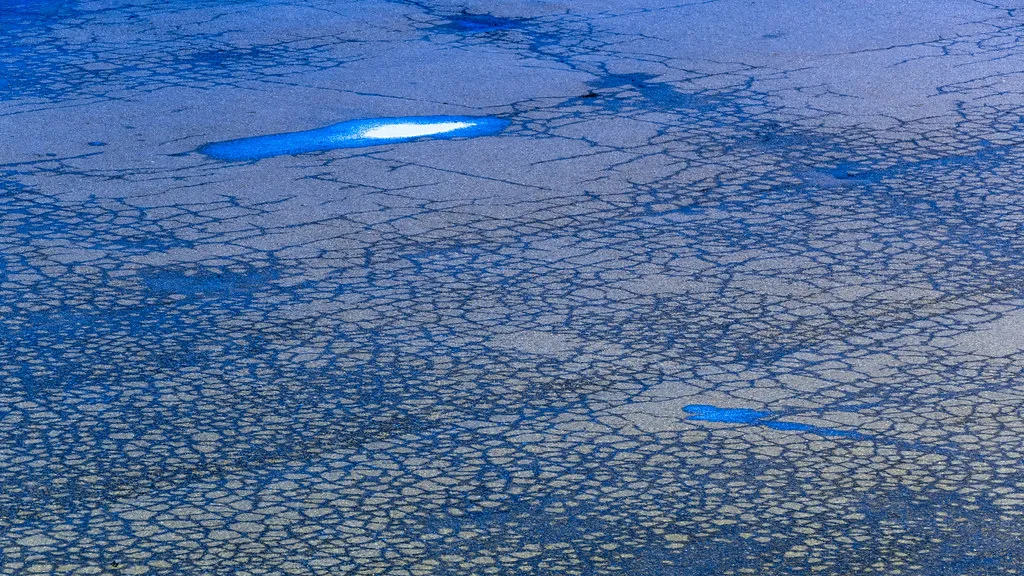
Both driveway briefs deal with water. The older brief says drainage provisions, the final crown and slopes need to be addressed, and that care should be taken to get a smooth surface that won't pond water. The 2020 Colorado brief says the surface should slope not less than a quarter inch per foot for good surface water drainage.
How to Reach the Long End of the Range
- Start with a proper build. Both briefs give the 20 years for a well-designed driveway, and the 2020 brief adds well constructed and maintained. If you are paving new, see our driveway paving service and the thickness guide above.
- Keep water moving off. Look for low spots where water stands after rain, and for water that runs onto the driveway from a downspout or the yard. The Colorado brief's quarter inch per foot is the slope to compare against.
- Fill cracks while they are small. Both briefs say small holes and cracks can be filled with driveway maintenance products readily available to homeowners. Our guide on filling cracks yourself or hiring it out compares the two.
- Seal it on a schedule. Both briefs say a high-grade asphalt liquid sealer applied every two to five years can extend the driveway's service life, and not to seal a new driveway until it is at least several months old. For the best time of year, see when to seal a driveway.
- Overlay a worn surface. The brief hosted by the Asphalt Institute says an existing driveway can be overlaid to improve its condition, strengthen it and extend its service life. Weak spots, holes and large cracks are cut out and patched with hot mix first. An overlay of 1.5 to 2 inches of surface mix is usually sufficient. Prices are in our New Jersey driveway resurfacing cost guide.
Damage You Can Measure
The Federal Highway Administration's Distress Identification Manual was written for rating pavement test sections in the federal Long-Term Pavement Performance program. We use its definitions because each kind of damage comes with a description and, for some of them, a measurement you can take with a ruler. Metric figures are the manual's; the inches are rounded conversions.
Fatigue (alligator) cracking
Cracks in the areas that carry repeated traffic, the wheel paths. Early on it can be a series of connected cracks. Later the cracks break the surface into many-sided pieces, usually under 0.3 meters (about 1 foot) on the longest side, in a chicken-wire or alligator pattern.
Low severity in the manual: an area of cracks with no or only a few connecting cracks, not spalled or sealed, with no pumping.
Block cracking
A pattern of cracks that divides the pavement into roughly rectangular pieces, about 0.1 to 10 square meters each (roughly 1 to 108 square feet).
Low severity: cracks with a mean width of 6 mm (about ¼ inch) or less, or sealed cracks whose sealant is in good condition. Moderate: wider than 6 mm and up to 19 mm (about ¾ inch), or any crack up to 19 mm with low-severity random cracking within 0.3 m (about 1 foot). High: wider than 19 mm, or any crack up to 19 mm with moderate or high-severity random cracking within 0.3 m.
Potholes
Bowl-shaped holes in the surface, at least 150 mm (about 6 inches) across.
Low severity: under 25 mm (about 1 inch) deep. Moderate: 25 to 50 mm (about 1 to 2 inches). High: deeper than 50 mm.
Raveling
The surface wearing away as stones come loose and the asphalt binder is lost, from loss of the fine material to a rough, pitted surface with obvious loss of stone.
The manual uses no severity levels for raveling. It says its presence indicates potential mixture-related performance problems.
Water bleeding and pumping
Water seeping or forced up from beneath the pavement through cracks. Sometimes the sign is fine material, washed out of the layers underneath, left on the surface and staining it.
No severity levels; the manual says the amount changes with moisture conditions.
What causes alligator cracking and how it is repaired are covered in our alligator cracking guide.
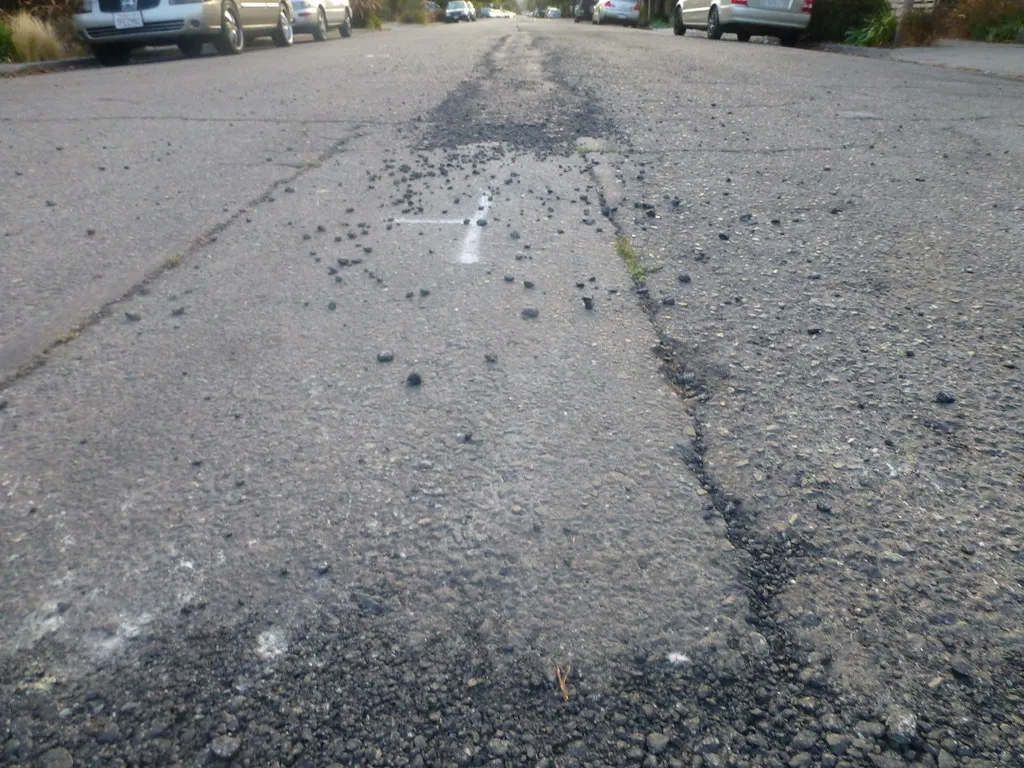
A Ten-Minute Check of Your Own Driveway
- Walk it after a rain and note where water stands or runs on.
- Measure the widest cracks. About a quarter inch (6 mm) is the line between the manual's low and moderate block cracking.
- Look at the tire paths for connected cracks forming small many-sided pieces.
- Measure any hole across and deep. The manual counts a hole as a pothole from about 6 inches (150 mm) across.
- Look for loose stones on the surface, and for fine material left around cracks after it rains.
Whether to repair, overlay or replace depends on the damage, how far it has spread and the base under it. Our repair or replace guide walks through that decision.
Questions From Homeowners
How long does an asphalt driveway last in New Jersey?
Two asphalt industry driveway briefs, one hosted by the Asphalt Institute and one from the Colorado Asphalt Pavement Association, say a well-designed driveway gives trouble-free service for up to 20 years; the 2020 brief says this of a driveway that is well designed, constructed and maintained. InterNACHI's life expectancy chart lists an asphalt driveway at 15 to 20 years. None of the three gives a separate figure for New Jersey. What New Jersey adds is freezing weather: NOAA's 1991 to 2020 normals count an average of 108.2 days a year with a low at or below 32°F at the Essex County Airport in Caldwell.
Does sealcoating make an asphalt driveway last longer?
Both driveway briefs say a high-grade asphalt liquid sealer applied every two to five years can extend the service life of the driveway and improve its appearance. They also say not to apply sealer until the driveway is at least several months old.
Can an old asphalt driveway be resurfaced instead of replaced?
The brief hosted by the Asphalt Institute says an existing driveway can be overlaid with hot mix asphalt to improve its condition, strengthen it and extend its service life. Weak spots, holes and large cracks are cut out and patched with hot mix first, and an overlay of 1.5 to 2 inches of surface mix is usually sufficient. The brief also says to inspect the site to determine conditions before giving advice.
How many days a year does it freeze in northern New Jersey?
NOAA's 1991 to 2020 normals give the Essex County Airport in Caldwell an average of 108.2 days a year with a low at or below 32°F, and 20.2 days with a high at or below 32°F. Newark Liberty International Airport averages 79.9 and 14.5. The difference is the days whose low reaches 32°F or below while the high rises above it: about 88 a year in Caldwell and about 65 in Newark.
Is Your Driveway Near the End of Its Life?
Randy Seal Coating & Striping paves driveways in Union, Essex, Passaic, Middlesex, Bergen and Morris counties. Ask us for a written estimate. Start with the driveway paving page, or send a note through the contact page.
Sources
Every source below was read on November 22, 2026.
- Asphalt Institute (Colorado Asphalt Pavement Association article): Best Practices for the Use of Asphalt Driveways, 2005 (PDF)
- Colorado Asphalt Pavement Association: Asphalt Driveways technical brief, March 2020 (PDF)
- InterNACHI: Standard Estimated Life Expectancy Chart for Homes
- NOAA NCEI 1991 to 2020 annual normals, Caldwell Essex Co AP, station USW00054743 (CSV)
- NOAA NCEI 1991 to 2020 annual normals, Newark Intl AP, station USW00014734 (CSV)
- NOAA NCEI: documentation of the 1991 to 2020 annual normals (PDF), definitions of the days at or below 32°F
- City of St. Louis Street Division: About Potholes and How They Are Repaired
- PennDOT: How Potholes Happen and How PennDOT Fixes Them, January 30, 2025
- Federal Highway Administration: Distress Identification Manual for the Long-Term Pavement Performance Program (PDF), asphalt pavement distresses 1, 2, 8, 13 and 15
Photos: zsolt.palatinus (Public Domain Mark), AnnSophieQ (CC0) and mlinksva (CC0), on Flickr.