Asphalt Driveway Edge Repair in New Jersey
A driveway edge breaks when nothing beside it holds it up and when tires or water keep working at it. California's highway maintenance guide puts edge failure down to traffic at the edge, water getting in there, or both. A lasting repair cuts the broken edge back to sound pavement, fills it with compacted hot-mix asphalt, and gives the new edge support at its side. Cold patch is a stopgap; the same guide calls cold mix a temporary fix. In New Jersey, timing matters as well. NOAA's 1991 to 2020 normals count an average of 108.2 days a year with a low at or below 32°F at the Essex County Airport in Caldwell.
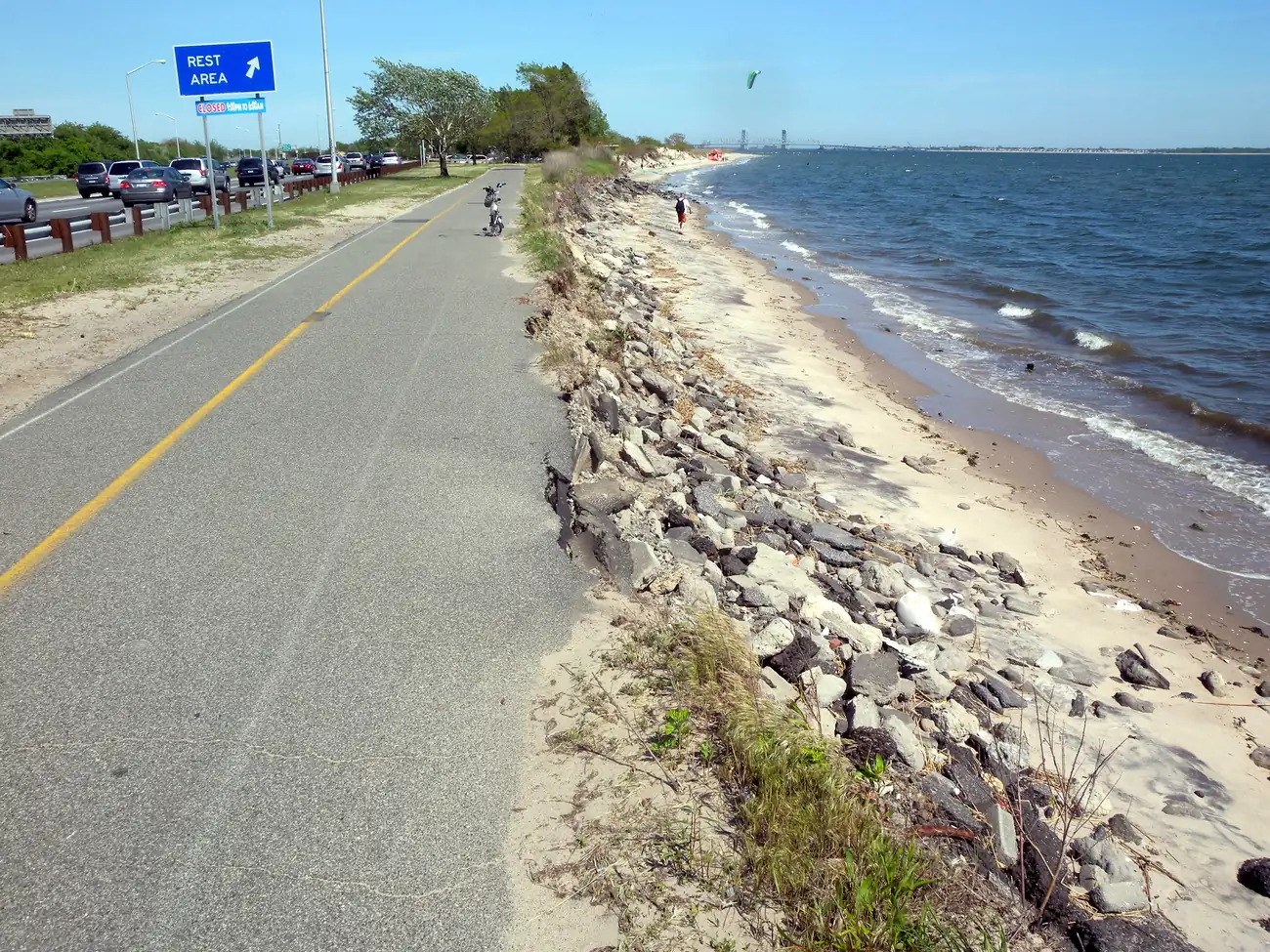
Three parts of a lasting edge repair, from the guides below
- The broken area is cut back, with square sides, to sound pavement.
- Hot-mix asphalt goes in and is compacted; where the base under the edge has failed, the repair goes deeper.
- The finished edge gets support and drainage at its side.
Why Driveway Edges Break
Caltrans, California's transportation department, publishes a maintenance guide with a chapter on patching and edge repair. It says edge failures are caused by traffic loading at the edge of the pavement, by water getting in at the edges, or by both. It describes edges failing from the action of traffic and from a loss of edge support, and it names three things behind that loss of support:
- water;
- aggressive-growth vegetation;
- wind, from traffic or the atmosphere.
State asphalt pavement associations put the same idea in homeowners' terms. Minnesota's driveway sheet says: The edges are the weakest part of your driveway due to the lack of side support.
It adds that driving on the edges may crack them and cause indentation. Maine's care sheet tells new-driveway owners to back up the edges with loam or gravel after paving, because the edges need that support. Wisconsin's owners guide says to keep vehicles away from the edges if the edges are not supported.
Put together, an edge that drops off to bare soil or a settled lawn carries weight with nothing beside it. Each tire that rolls onto it, and each rain that soaks the ground next to it, works the same weak point.
How Bad Is It? The Federal Measure for Edge Cracking
The Federal Highway Administration's Distress Identification Manual, written for the road surveys of its Long-Term Pavement Performance program, defines this damage. Edge cracking is crescent-shaped or fairly continuous cracks that meet the pavement edge and lie within 0.6 meters (about 2 feet) of it. It also includes lengthwise cracks outside the wheel path within that same 0.6 meters of the edge. The manual applies the term only to pavements with unpaved shoulders, much like a driveway edge that meets lawn or gravel. It sorts edge cracking into three severity levels:
On a phone, swipe the table sideways to see both columns.
| Severity | What the manual describes |
|---|---|
| Low | Cracks with no breakup or loss of material. |
| Moderate | Cracks with some breakup and loss of material for up to 10 percent of the length of the affected portion of the pavement. |
| High | Cracks with considerable breakup and loss of material for more than 10 percent of the length of the affected portion of the pavement. |
At low severity, no material has broken away yet. For a crack that develops over time from expansion and contraction, Wisconsin's owners guide says to fill it with crack filler in the spring to keep water out of the layers underneath; our guide to filling cracks yourself or hiring it out covers that job. Once pieces are breaking away, the cut-and-patch methods in the next section are how road agencies repair it.
A quick check at home: walk the driveway's sides with a tape measure. Note how far in from the edge the cracks reach, whether pieces are loose or missing, and how much of the edge's length is affected.
How Road Agencies Repair a Failed Edge
Caltrans splits edge repair by how deep the damage goes. If it is mostly in the asphalt surface, the crew follows its regular patching steps. If the deterioration extends well below the surface, a dig out is more appropriate. In both cases, the guide says, the aim is better lateral support along the edge, so it calls for extra care with compaction and drainage where the pavement meets the shoulder.
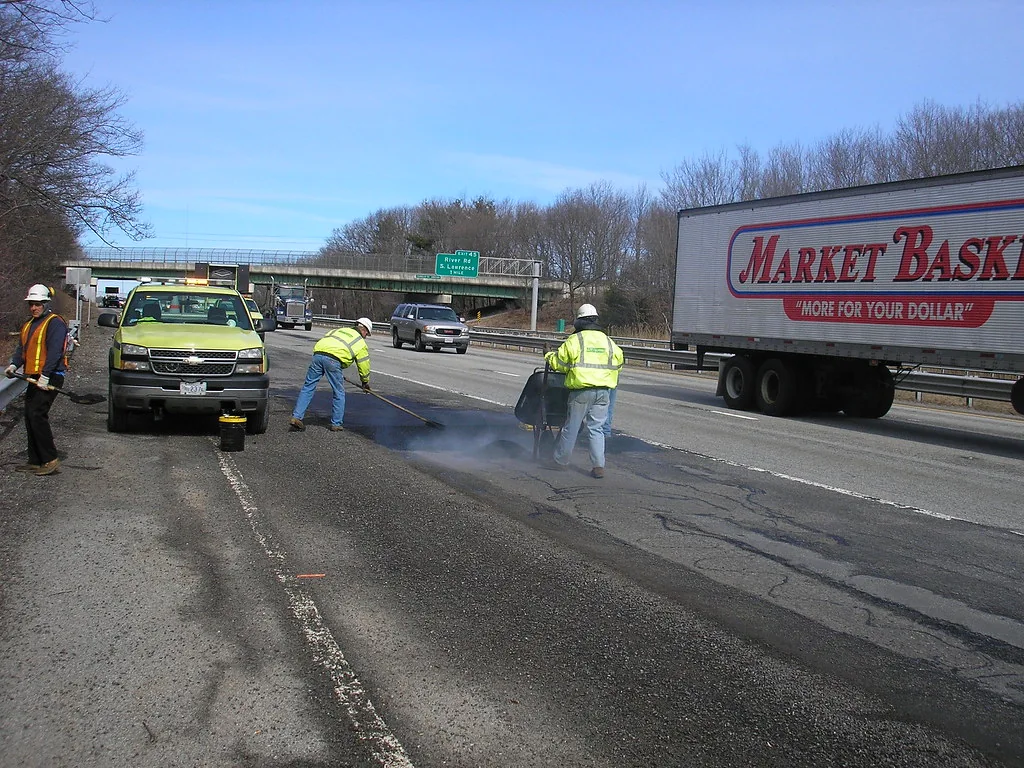
Damage in the surface: a cut-and-fill patch
Of its patching methods, Caltrans ranks the semi-permanent patch second only to removing and replacing the failed area. Its steps, in order and shortened:
- Mark a boundary a little larger than the damage, as rectangular as possible.
- Cut the boundary square with a diamond saw or a pneumatic hammer with a spade bit, then square up the sides until they are sound pavement. The guide suggests making the patch 50% thicker than the failed layer.
- Remove water and debris from the hole.
- Spray or brush a tack coat of asphalt emulsion on the sides and bottom, about 0.2 gallons per square yard. The guide says never to pour it.
- When placing by hand, shovel the hot mix in rather than raking it, to avoid segregation, and overfill the hole by 20 to 25 percent of its depth so there is material to compact. A rake then feathers the patch edges.
- Compact with a hand device or a small vibratory roller, preferably one smaller than the patch, and leave a crown of 0.1 to 0.2 inch (3 to 6 mm).
- Seal the edges of the patch with crack sealant; where rainfall is heavy, fog seal the whole patch.
Damage into the base: a dig out
Caltrans says that when the edge of the pavement has broken away, or the base has failed from severe alligator cracking, the failed asphalt and base materials typically have to be dug out. Its dig out steps, in order and shortened:
- Mark the boundaries of the area to be replaced, aiming for a rectangle.
- Cut the perimeter with a diamond saw or cold milling machine, then break out the failed pavement down to the subgrade.
- Clean and dry the dig out area.
- Leave room for new hot mix at least 50% as thick as the existing asphalt, preferably 100%. If the hole is more than twice as deep as the existing asphalt layer, place and compact new base course first.
- Tack the sides, then place the hot mix, which for a dig out generally uses larger aggregate (½ to ¾ inch).
- Place it in lifts when the repair is deeper than 4 inches, with no lift over 4 inches, and compact each lift with equipment narrow enough to fit inside the repair.
- Finish with a crown of ⅛ to ¼ inch. Before traffic returns, the guide recommends sealing the seams with crack sealant and fog sealing the patch.
Washington State's maintenance manual, for a full-depth dig out, says to extend the excavation about 12 inches (1 foot) into the good pavement around the damage, cut the edges vertically and in straight lines, and compact the asphalt in lifts of no more than 3 inches.
Backing Up the Edge So It Holds
A repaired edge with nothing beside it has the same weakness as the old one. The three associations' advice for the side of a driveway:
- Maine: back up the edges of fresh pavement with loam or gravel after paving.
- Minnesota: build up the sides of the driveway with topsoil, which supports the edges and looks better once grass grows.
- Wisconsin: keep the edges supported with stone, gravel, topsoil or grass, and keep vehicles off edges that are not supported.
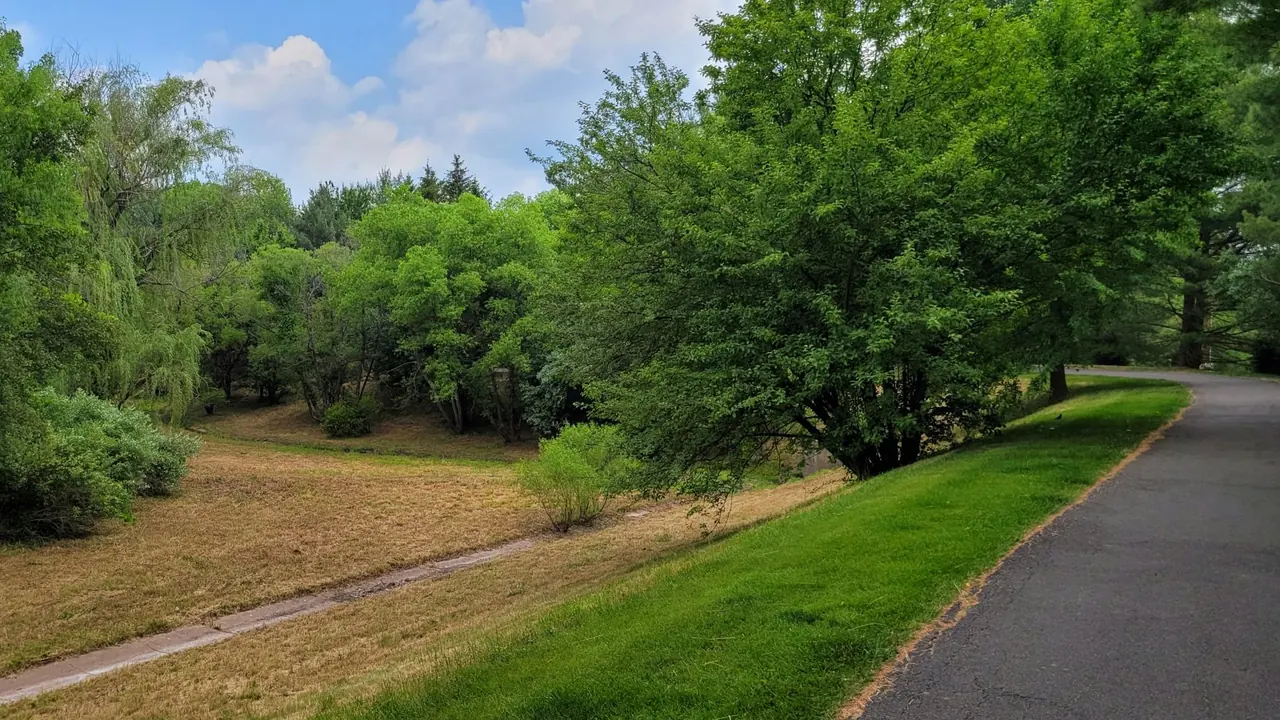
Drainage matters at the same spot. Caltrans asks for good drainage where a repaired edge meets the shoulder, and Wisconsin's guide calls it vital that water drains off a driveway and away from the home. Water that ponds against a repaired edge is the same water Caltrans names as a cause of edge failure.
Edge Repair and New Jersey Weather
Northern New Jersey freezes often. NOAA's 1991 to 2020 normals give these averages:
- Caldwell, Essex County Airport: 108.2 days a year with a low at or below 32°F.
- Newark Liberty International Airport: 79.9 days a year with a low at or below 32°F.
Wisconsin's owners guide names spring, during the freeze-thaw cycle, as a time when pavement is most susceptible. Caltrans says patching is best done in clear, moderate weather. Emergency patches made in poor winter weather are likely to have poor durability and should be considered temporary, and the guide suggests planning a more lasting repair for when moderate weather returns. Its project inspection table for hot-mix dig outs and edge repairs asks whether the weather will be fair and above freezing for at least 48 hours after patching.
New Jersey's own road specification sets a floor for hot mix. Under NJDOT's 2019 Standard Specifications, Table 401.03.07-1, the base being paved on must be at least this warm when hot-mix asphalt is placed:
| Thickness of the layer being placed | Minimum base temperature |
|---|---|
| 1 inch or less | 50°F |
| More than 1 inch and less than 2 inches | 41°F |
| 2 inches or more | 32°F |
That table is written for state road contracts, not driveways, but it shows why a thin hot-mix repair waits for warmer days. An edge that breaks in December can be held with cold patch, which the Caltrans guide treats as temporary, and then cut and patched with hot mix when the weather allows. Ask your contractor what base temperature they work to.
When a Broken Edge Points to More
Caltrans notes that edge failures usually sit outside the main wheel paths, yet they can speed up the deterioration of the pavement that traffic uses. On a driveway, check the rest of the surface while you are looking at the edges:
- Connected cracks in the tire paths: our alligator cracking guide.
- A driveway near the end of its service life: how long an asphalt driveway lasts in New Jersey.
- Whether to patch, overlay or start over: our repair or replace guide.
Questions From Homeowners
Why are the edges of my asphalt driveway crumbling?
California's highway maintenance guide gives two causes of edge failure: traffic loading at the edge, and water getting in at the edges. It also says edges lose their support to water, aggressive-growth vegetation and wind. Three state asphalt pavement associations give the homeowner's version: an edge has no side support unless something is placed against it, and Minnesota's sheet calls the edges the weakest part of a driveway for that reason.
Can I fix a crumbling driveway edge with cold patch?
As a stopgap, yes. California's guide lists cold mix as a temporary fix only for patching and an emergency fix only for dig outs, with hot-mix asphalt preferred for both. Its least expensive pothole method, throw and roll, is described as appropriate only when the weather is too poor for a semi-permanent patch or the road is due to be rehabilitated soon. A lasting repair cuts the edge back to sound pavement and places compacted hot mix.
Can driveway edges be repaired in winter in New Jersey?
Emergency patches can go in, but California's guide says a patch placed in poor winter weather is likely to have poor durability and should be considered temporary, and its project inspection table for hot-mix dig outs and edge repairs asks whether the weather will be fair and above freezing for at least 48 hours after patching. For its own road work, NJDOT does not allow hot-mix asphalt to be placed on a base colder than 50°F when the layer is 1 inch thick or less. NOAA's 1991 to 2020 normals count an average of 108.2 days a year with a low at or below 32°F in Caldwell and 79.9 in Newark.
How do I keep a repaired edge from breaking again?
Give the edge support and keep water and wheels off it. The Maine association says to back up the edges of fresh pavement with loam or gravel, Minnesota's suggests building up the sides with topsoil, and Wisconsin's says to keep vehicles away from edges that are not supported. California's guide asks for good compaction and good drainage where a repaired edge meets the shoulder beside it.
Edges Crumbling on Your Driveway?
Randy Seal Coating & Striping patches and repairs asphalt in Union, Essex, Passaic, Middlesex, Bergen and Morris counties. Ask for a written estimate, and ask how the repair will be cut, compacted and backed up at the side. Start with the asphalt repair page, or send a note through the contact page.
Sources
The sources below were read on November 22 and 23, 2026.
- Caltrans Maintenance Technical Advisory Guide, Chapter 5: Patching and Edge Repair (PDF)
- Washington State DOT Maintenance Manual M 51-01, Chapter 3: Pavement Patching and Repair (PDF)
- Federal Highway Administration: Distress Identification Manual for the Long-Term Pavement Performance Program, FHWA-HRT-13-092, Chapter 1, distress 3, edge cracking
- Minnesota Asphalt Pavement Association: Driveway Reminders (PDF)
- Maine Asphalt Pavement Association: Care and Maintenance of your new Driveway (PDF)
- Wisconsin Asphalt Pavement Association: Driveway Owners Guide
- NJDOT Standard Specifications for Road and Bridge Construction, 2019, section 401.03.07.B and Table 401.03.07-1 (PDF)
- NOAA NCEI 1991 to 2020 annual normals, Caldwell Essex Co AP, station USW00054743 (CSV)
- NOAA NCEI 1991 to 2020 annual normals, Newark Intl AP, station USW00014734 (CSV)
Photos: Jim Henderson via Wikimedia Commons (public domain), MassDOT on Flickr (Public Domain Mark) and Seth Goldstein via the WordPress Photo Directory (CC0).