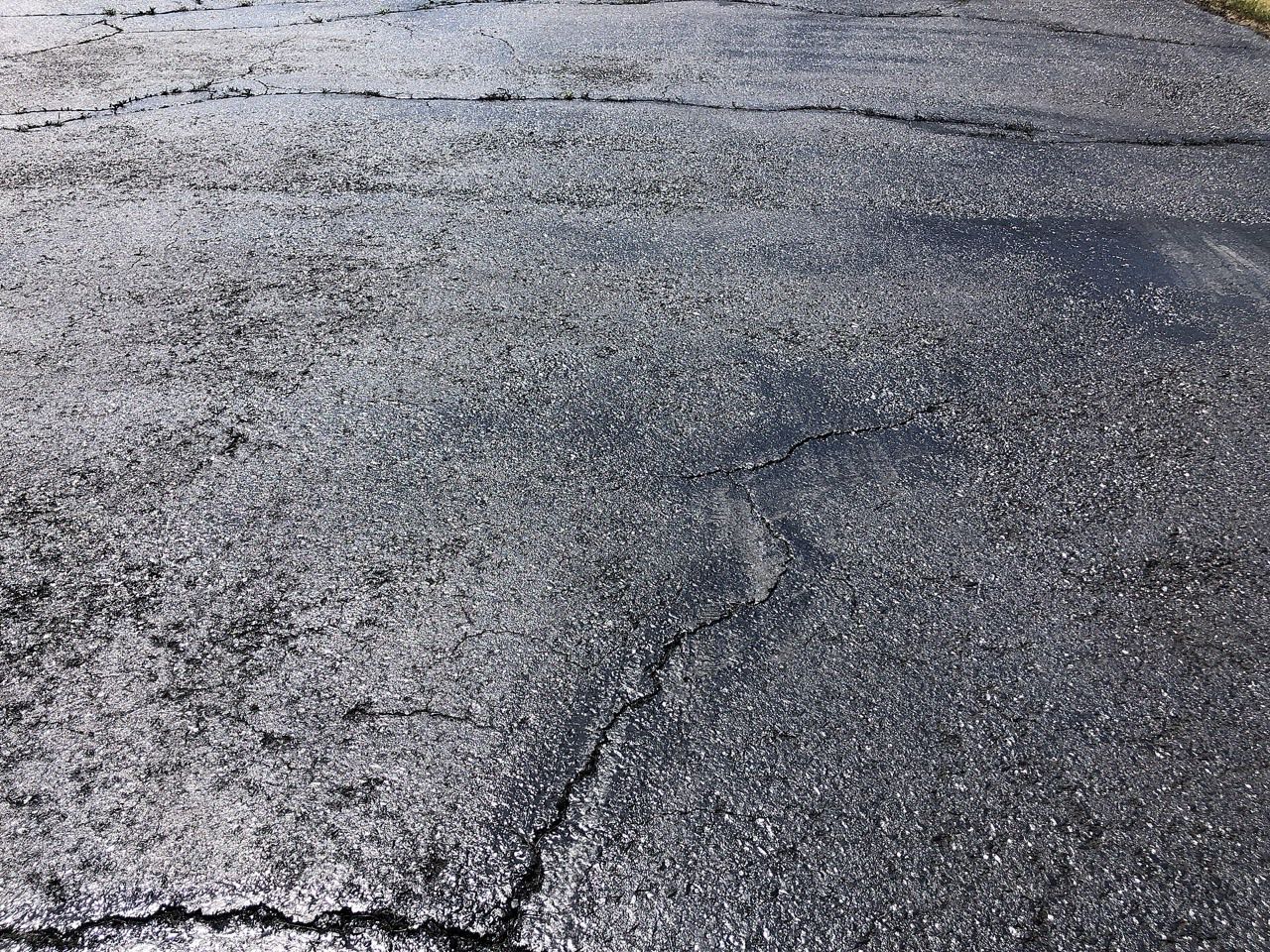
The Challenge: A Hillside Driveway Failing After Every Winter
Clifton's Allwood neighborhood is known for its tree-lined streets, established homes, and—for contractors—its challenging terrain. The neighborhood sits on the slopes leading up toward Garret Mountain, which means many properties have sloped or hillside driveways.
Roberto and Elena Martinez contacted me in late fall 2025 about their driveway on Valley Road. They'd lived in their 1962 colonial for 18 years and had replaced the driveway once before, in 2009.
"That last driveway was supposed to last 20 years," Roberto explained. "It's been 16, and it's falling apart. Worse than the original."
When I arrived, I immediately understood the problem. The 2009 installation had been done incorrectly for the property's specific conditions:
- 12% grade (roughly a 7-foot rise over 60 feet of length)
- No edge containment - asphalt was literally sliding downhill over time
- Inadequate drainage - water ran down the surface and pooled at the garage
- Too thin - previous contractor used 2.5 inches total (insufficient for the slope stress)
- No base preparation - they'd paved directly over failing substrate
The result was a driveway that developed new cracks every winter and had shifted 4 inches downhill since installation.
Why Hillside Driveways Fail
Before detailing our solution, it's important to understand why the previous installation failed—and why many hillside driveways in Clifton, Wayne, and similar Passaic County communities experience similar problems.
Gravity Never Stops Working
On a flat driveway, asphalt sits relatively stable. On a slope, gravity constantly pulls on the material. During summer heat, when asphalt becomes slightly more pliable, this gravitational force causes incremental movement—sometimes called "creep." Over years, this creep accumulates, causing:
- Edge deterioration at the downhill side
- Cracking perpendicular to the slope
- Surface waves or rippling
- Separation from the garage apron
Water Accelerates Everything
Hillside properties naturally funnel water downhill. Without proper drainage engineering:
- Water runs across the surface at high velocity, eroding the asphalt
- Water concentrates at the low point (usually the garage door)
- Freeze-thaw cycles are more destructive due to water volume
- Subsurface erosion undermines the base
Standard Specifications Don't Apply
A driveway that works perfectly on flat ground will fail on a 12% slope. Hillside installations require:
- Thicker asphalt layers
- Edge containment systems
- Enhanced base preparation
- Drainage integration
- Proper cure time consideration
The Solution: Engineered for Slope and Climate
Pre-Construction Analysis
Before proposing a solution, I needed to understand the Martinez property's specific conditions:
- Surveyed the grade - Confirmed 12% average, steeper (15%) near street
- Assessed drainage patterns - Water flowed from neighbor's property across driveway
- Tested soil conditions - Found clay-heavy soil prone to water retention
- Measured existing base - Confirmed base failure requiring complete reconstruction
The Design
Our engineered solution addressed each failure mode:
1. Complete Excavation and Base Reconstruction - Removed all existing asphalt and failed substrate - Excavated to 12 inches below final grade - Installed 8-inch compacted aggregate base (vs. typical 4-6") - Applied geotextile fabric between soil and aggregate to prevent migration
2. Edge Containment System - Installed concrete curbing along both sides - Curbs extend 4 inches above asphalt surface - Keyed 6 inches into the base - Prevents lateral movement and contains the asphalt
3. Integrated Drainage - Installed French drain along uphill edge to intercept neighbor's runoff - Created swale at property line to redirect surface water - Sloped driveway slightly crown (center higher) to shed water to sides - Added drain grate at garage apron connected to yard drain
4. Heavy-Duty Asphalt Specification - 3-inch base course (vs. typical 2") - 2-inch surface course (vs. typical 1.5") - Total 5 inches of asphalt (double a standard residential spec) - Used polymer-modified binder for flexibility
The Installation: Three Days of Precision Work
Day 1: Demolition and Excavation
7:00 AM - Crew of 4 arrived with excavator and haul truck 7:30 AM - Began removing old asphalt (broke into sections for loading) 10:00 AM - Asphalt removal complete; began excavating failed base 12:00 PM - Discovered additional soft spot requiring 16" excavation 2:00 PM - Full excavation complete; installed geotextile fabric 4:00 PM - First 4 inches of aggregate delivered and spread 5:30 PM - Initial compaction; site secured overnight
Day 2: Base Completion and Curbing
7:00 AM - Remaining aggregate delivered 8:00 AM - Final 4 inches of base installed 10:00 AM - Multiple-pass compaction (vibratory roller + plate compactor) 12:00 PM - Formed and poured concrete edge curbing 3:00 PM - Installed French drain along uphill property line 5:00 PM - Final grading check; allowed curbing to cure overnight
Day 3: Paving and Finishing
7:00 AM - Asphalt delivery (base course material) 7:30 AM - Applied 3-inch base course in two lifts 9:30 AM - Initial compaction of base course 10:30 AM - Surface course asphalt delivered 11:00 AM - Applied 2-inch surface course 12:30 PM - Final rolling (minimum 6 passes for slope stability) 2:00 PM - Joint sealing at curbing and garage apron 3:00 PM - Drain grate installation at garage 4:00 PM - Final cleanup and inspection
The Investment
| Component | Details | Cost |
|---|---|---|
| Demolition & excavation | Complete removal to 12" | $2,800 |
| Base system | 8" aggregate + geotextile | $3,200 |
| Concrete curbing | 120 linear feet both sides | $2,400 |
| Drainage system | French drain + grate + piping | $1,800 |
| Asphalt paving | 5" total (3" base + 2" surface) | $5,200 |
| Total Investment | $15,400 |
Why This Cost More Than Standard
A comparable-sized flat driveway (650 sq ft) would typically cost $4,500-6,000. The Martinez project cost $15,400 because:
- Deeper excavation required for proper base
- Extra aggregate for 8-inch base vs. standard 4-inch
- Concrete curbing adds $2,400
- Drainage system adds $1,800
- Thicker asphalt (5" vs. 3") adds material and labor
Is it worth it? Absolutely. The previous "economy" installation lasted 16 years with constant maintenance headaches. Our engineered installation carries a 20+ year expected lifespan with minimal maintenance—and no sliding downhill.
The Outcome
Six months after installation, I visited the Martinez property to check on the driveway through its first winter:
> "That first heavy snow in January—usually I'd be out there afterwards looking for new cracks. This year? Nothing. The water that used to pool by our garage door now goes into that drain you installed. For the first time in years, I can walk to my car in winter without stepping in ice. My neighbor asked who did the work. I told him to call you." > > — Roberto Martinez, Allwood, Clifton
Performance Observations
- Zero cracking through first freeze-thaw season
- No edge deterioration (curbing working as designed)
- Garage area stays dry (drainage system functional)
- No settlement or movement (enhanced base holding)
Lessons for Clifton Hillside Properties
1. The Allwood-Athenia Factor
Clifton neighborhoods with significant terrain—Allwood, Athenia, and areas near Garret Mountain—require specialized driveway approaches. A contractor who doesn't account for slope is setting you up for premature failure.
2. Questions to Ask Your Contractor
If you have a sloped driveway, ask any contractor:
- "How will you prevent the asphalt from creeping downhill?"
- "What's your specification for base depth on slopes?"
- "How will you manage water drainage?"
- "Do you install edge containment?"
If they can't answer specifically, find a contractor who can.
3. The True Cost of "Cheap"
The Martinez's 2009 driveway cost approximately $5,500. It failed prematurely and required constant patch repairs (estimated $2,000 over 16 years). Our replacement cost $15,400.
Net difference: $7,900 more upfront. But our installation will likely last 25+ years maintenance-free, while they would have needed another $5,500 replacement soon anyway.
4. Drainage is Non-Negotiable
Every hillside driveway project should include drainage analysis. Water is the primary destroyer of asphalt. Managing it properly extends pavement life dramatically.
Does Your Clifton Driveway Need Attention?
If your property is in Clifton's hillside neighborhoods, watch for these specific warning signs:
Slope-Related Failure Indicators: - Cracks running perpendicular to the slope direction - Visible gap between driveway and garage apron - Edges crumbling at the downhill side - Waves or ripples in the surface - Evidence the driveway has "moved" over time
Drainage Problems: - Water pooling at the garage - Erosion channels across the surface - Ice forming in the same spots every winter - Mud or sediment washing across the driveway
General Deterioration: - Alligator cracking (interconnected cracks) - Multiple patched areas - Surface oxidized to gray - Base material visible through cracks
Ready for Your Clifton Driveway Assessment?
Randy Seal Coating & Striping has served Clifton and Passaic County homeowners for over 18 years. We understand the specific challenges of hillside properties and engineer our solutions accordingly.
What You Get:
- Slope analysis and grade measurement
- Drainage assessment included with every estimate
- Custom specifications for your property's needs
- Written warranty on materials and workmanship
- Honest advice about what your driveway actually needs
Contact Us: - Phone: Call Randy - Email: randy@sealcoatingandstriping.com - Online: Request Your Free Estimate
Serving Clifton and all of Passaic County: Clifton | Paterson | Passaic | Little Falls | Woodland Park | Wayne
Hillside driveways require hillside expertise. Call Call Randy today.
Ready to Protect Your Asphalt?
Get a free quote for professional asphalt maintenance and protection services. Our team is ready to help extend the life of your driveway or parking lot.